Shopping Cart
€25.00 more for free shipping.
 Bold hair accessories

Many people give up on the headband not because they don't like its style, but because they associate it with too much pressure after a few hours. The sensitive temples are a particularly revealing area: as soon as an accessory tightens too much or distributes tension poorly, discomfort quickly appears, sometimes as early as morning coffee. A wider headband then deserves to be looked at closely. It does not promise a secure hold at all costs, but a more balanced relationship between support and comfort.
The bad reflex is to seek maximum grip. We want it to hold, so we tolerate increasing tightening, until the moment when the hairstyle becomes a source of distraction. An aggressive outfit is not a good outfit. A successful accessory remains present without monopolizing the attention of the wearer. On sensitive temples, this principle becomes central.
Four widths and materials from the collection, to really wear until the evening. free shipping from €25.
We often look for a headband that does not hurt when in reality we are describing a soft headband. The three words designate the same gesture, framing the hair above the forehead, but they do not cover the same objects. A rigid headband, made of plastic or metal, is a headband: it remains on two points, one behind each ear, just at the level of the temples. All the tension is concentrated there. This is precisely the worst scenario when this area reacts quickly.
A large headband, or headband in fabric, works differently. The band remains on its entire surface and the rear hair elastic closes the head circumference without any hard spots. The weight is distributed across the scalp instead of falling on two millimeters of skin. It is this difference in mechanics, more than the brand or the pattern, which explains why one model triggers a headache at the end of the day and the other does not. If you want to compare the ways of placing it, our article on how to wear a headband details the possible positions.
A useful nuance: a padded, wide, fabric-covered headband is very similar to a headband. What matters is therefore not the name on the label, but two things that can be measured by hand, the width of the band and the flexibility of the closure.
A wider headband distributes the support over a more generous surface. This doesn't remove all pressure, but it prevents it from concentrating on a narrow line near the temples. The difference may seem subtle at first, but then become very clear after two or three hours of screen time, travel, or conversation. Where a thinner model marks or tires you, a looser headband better accompanies the micro-movements of the head, jaws and face.
The scalp is as important as the skin on the temples. A narrow band pulls on a single line of roots and this traction goes back up: it is often this that we feel as the beginning of migraine tension, not the lateral pressure itself. By widening the support surface, we divide the load by root. Fine hair gains a lot, because they offer less natural cushion between the accessory and the skull.
This distribution also affects visual perception. A wide headband often appears more composed, less nervous in the hairstyle. Over long days, this impression of gentle stability is precious: it allows you to wear the accessory without constantly remaining in dialogue with it.
At equal width, two headbands do not wear the same. cotton gauze is crinkled, lightweight and breathable; it follows the shape of the skull and forgives small placement errors. It is the most forgiving material on sensitive temples, especially in summer or in an overheated office. The satin slides more: very soft on the hair, it requires a little more tension to stay in place, which can work against you if the area reacts quickly. The velvet grips well and holds loosely, but it keeps you warm and is more noticeable.
The lining and the rear hair elastic are worth a look. A thin and stiff hair elastic creates a hard point at the nape of the neck, and this hard point is almost always compensated by pulling forward, therefore on the temples. A large hair elastic, or hidden under the fabric, distributes the closure better. Our cotton gauze headbands and scrunchies clearly illustrate this compromise between lightness and support.
In the collection, the Alba Leopard Nude headband is the most useful to mention here: wider, it structures the upper part of the face and diffuses support more. The nude pattern can be read without shouting; he frames. It is often the first model to test if your temples already react to a thin headband worn for an hour.

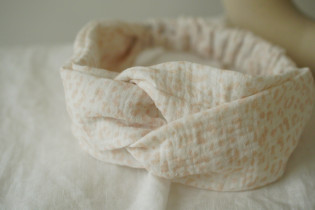
The headband Céliane floral ivory peach sage brings a softer, flowery, satiny reading. It works well for days when you want a visual frame without feeling cramped. Place it a little back if the temple area is already tired (glasses, headphones, screen time).

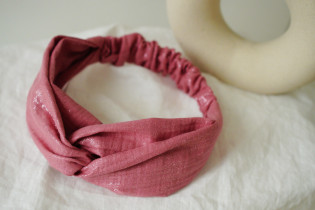
The glittering pink Aélia headband is more visually present. It is not “forbidden” for sensitive temples, but it requires honest placement: slightly set back, without pulling forward to “hold”. If you already feel a hard spot after twenty minutes, it's not you who is too sensitive. It's the tension or the width that is not correct.

We must accept that a good headband is not a vice. Many implicit promises around accessories are based on an idea of absolute fixation. However, in a normal life, you especially need an accessory that accompanies the office, journeys, conversations and small variations in posture. A model that is too cramped often ends up being removed before the end of the day. A comfortable model is actually worn.
On sensitive temples, the priority is therefore clear: find a reasonable, stable, but never punitive hold. This sometimes requires reviewing your investment habits. A headband slightly moved back, or placed with a little less frontal tension, can already change the feeling without taking away from the clarity of the result.
It is useful for extended screen days, with glasses, headphones, or simply when general fatigue makes any pressure more noticeable. It may also be better suited to people who have a lot of mass around their face or strands that need to be contained without being crushed. Its visual presence then becomes an advantage: it naturally structures the hairstyle at the same time as it better distributes the support.
Both extremes of hair find their benefit, for opposite reasons. On hair fins, the width prevents the strip from digging a line in the roots and then sliding towards the forehead. On thick hair, it contains volume without having to compensate with tightening. Same logic in movement: during a yoga session or a brisk walk, the combo headband and scrunchie holds better than a very tight headband alone.
A wider headband is not reserved for a specific style. It can seem romantic, sober, urban or very everyday depending on the material and the way you wear it. However, its main interest remains very concrete: it makes the accessory more habitable. And that often matters more than fashion.
The glasses arms already occupy part of the temple. If the headband passes right on the same line, you stack two pressures. Move the headband back slightly or choose a width that extends beyond this line instead of duplicating it. With a light helmet, avoid adding a headband that is too thick under the headband: superposition creates a hard point in a few minutes, even if each object taken separately is comfortable. The subject comes up every day when working remotely, and we have covered it separately in our article on the trio headband, headphones and video.
The jaw counts too. Talking for a long time, chewing, laughing: all of this moves the skin near the temples a little. A headband that is too narrow then “cuts” a fixed line. A wider headband follows this movement better. This is one of the reasons why the problem appears at the end of the afternoon, not during the morning pose.
The right criterion is not the effect at the fifth minute, but that of the end of the day. If you almost forget the headband over the hours, that's a good sign. If you already feel the temples reacting during morning coffee, it's probably not the right width or tension. This honesty of use is worth more than any theoretical promise.
To compare models designed to frame the face without attacking it, Alba Leopard Nude, Céliane fleur and Aélia sparkling pink, discover our selection of Bohomane hair headbands. You will be able to more easily identify the widths that give real room for comfort. And if you are still hesitating between several materials or several sizes, our headband hair purchase guide covers the subject width by width.
In front of the mirror: put the headband on, speak out loud, turn your head, lean towards a keyboard. If a specific spot already stings, it will sting more in two hours. Step back a few millimeters, release frontal tension, repeat. The right headband for sensitive temples is not the one that “holds the most”. It’s the one you don’t want to take off.
Not necessarily. It holds differently, with often pressure better distributed. The sensation can be softer without the hairstyle losing stability, especially with an Alba Leopard Nude type model.
A wide and flexible model, in fabric, with a rear hair elastic that closes without any hard spots. The rigid plastic hoops press on two points located right on the temples: with equal sensitivity, a cotton gauze headband will almost always be more bearable.
The two are often linked. If the headband marks quickly or creates a specific point of discomfort, try a more generous width and a slightly less tight placement.
Yes, when the traction is concentrated on a root line that is too narrow. It is a tension of the scalp more than a pain in the skin, and it manifests itself especially after three or four hours of wear. Widening the band and loosening the front is often enough to make it disappear.
Yes, provided you monitor the space around the branches. The correct placement must allow the two to coexist without creating an additional hard point on the same temple.
No, not as a first instinct. Move it back slightly and bring a little hair under the band to create grip, rather than increasing frontal tension. On fine, satin hair, a velvet model naturally sticks better than a smooth satin.
This is often a good first try: wider, discrete pattern, more diffused support. Test it on a real half-day of screen time, not just five minutes in front of the mirror.
The material and width matter more than the pattern. Céliane fleur can be very comfortable; Aélia, more scintillating, especially requires placement without tightness.
The jaw, speech, glasses and helmet move the skin a little. A headband that is too narrow then cuts into a fixed line; a wider headband follows this movement better.
Pose, speak, turn your head, lean. If a spot is already stinging, step back a few millimeters before exiting.
-10%
on your
next order
promo code sent by email
no spam ♡